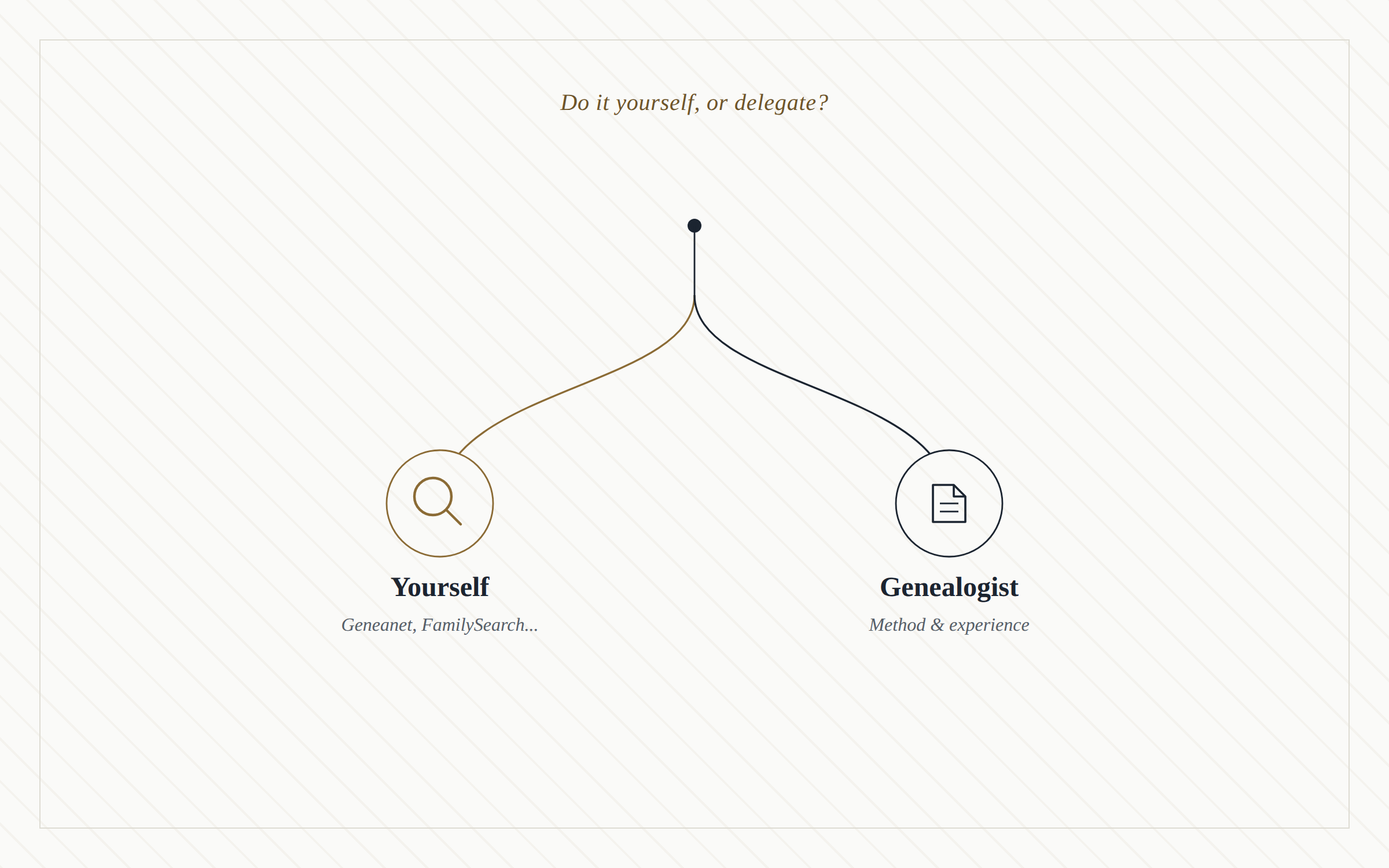
This is a question I'm regularly asked, and it deserves an honest answer rather than a disguised sales pitch. With platforms like Geneanet, Filae or FamilySearch, it's now possible to build a family tree for free, from your sofa, without ever setting foot in a physical archive. So is hiring a professional genealogist really necessary, or is it paying for work you could do yourself?
The honest answer is: it entirely depends on what you're looking for, and how much time you're willing to invest instead of money.
Let's start by giving credit to the free tools, because they really are excellent at what they do. Geneanet and FamilySearch provide access to millions of digitised records, family trees already built by other amateur genealogists, and powerful search tools. For a simple family tree, going back three or four generations, with uncommon surnames and well-documented towns, it's entirely possible to do it all yourself, for free, over a few weekends of research.
The problem is that most family trees don't stay simple for long. Here are the situations where working alone gets seriously complicated, and where the question of a genealogist's price takes on a different meaning.
The first difficulty is old handwriting itself. A record from 1850 is fairly readable with a bit of practice. A record from 1650, on the other hand, requires real familiarity with letters that no longer exist, Latin abbreviations, and completely different spelling. Hours can be lost on a single word, with no guarantee of success.
The second difficulty, more insidious, is mistaken identity. Two people with the same name, born the same year in neighbouring towns — this was extremely common in rural France before the 20th century, where the same first and last names tended to cluster in small geographic areas. Without a rigorous cross-checking method, it's very easy to build an entire family tree on the wrong branch, for years, without ever noticing.
The third difficulty is that not all archives are digitised. Parish and civil records largely are, but notarial deeds, detailed military archives, complete censuses or certain departmental collections sometimes remain accessible only in person, or require knowing exactly what to ask for and where to look. A professional genealogist is used to navigating these less accessible collections.
The fourth difficulty, almost always underestimated, is the real time it takes. Serious research across five generations, with cross-checking of every piece of information, easily represents ten to fifteen hours of work for someone experienced. For a beginner learning the method, the tools and palaeography at the same time, that figure can easily triple. Converted into an hourly wage, even a modest one, the "free" option quickly becomes debatable.
Now let's look at what actually changes when you pay a professional genealogist. It isn't just paying for access to archives, since those archives are, for the most part, freely accessible to everyone. It's paying for three specific things: the method, which avoids the pitfalls of mistaken identity and wrong attribution; the reading experience, which lets you decipher in minutes what would take a beginner hours; and the final writeup, which turns a collection of records into a coherent, verifiable document that the whole family can read, not just the person who built it.
On the price of a genealogist, rates vary enormously depending on how deep the research needs to go. Simple research across a few generations can cost between €60 and €100. In-depth research across five generations, cross-referencing several types of sources with a written narrative, more often falls between €150 and €250. Beyond that, for very extensive research or family trees going back several centuries, rates are usually calculated hourly or per additional generation.
This price may seem high at first glance, but it should be compared to what it actually represents: several dozen hours of specialised work, the guarantee of a rigorous method, and a finished document with real value for passing down family history, especially when given as a gift to a parent or grandparent.
So, should you hire a genealogist or do it all yourself? My honest answer is that there's no universal right answer, only a right answer for your situation. If you have time, patience, and a family tree that stays simple, go ahead alone with Geneanet or FamilySearch: it's rewarding, and it's free. If your research is stuck, if you're short on time, or if you want a reliable, well-presented result without spending dozens of hours on it, hiring a professional genealogist becomes a perfectly rational choice, not a luxury.
A hybrid approach also works very well: many of my clients have already started on their own, hit a specific dead end, and hand over only the part that's stuck. This is often the most economical and satisfying solution: you keep the enjoyment of discovery for what you can do yourself, and you delegate what would likely remain stuck for years without expertise.
If you're in this situation, with research underway that isn't moving forward, feel free to describe where you're at: I can tell you honestly whether the blocker calls for a simple nudge or more in-depth research. You can also check my rates and research packages directly.