Prosapia
Archive files

What research becomes, once it's written

Three narrative excerpts, in different tones, and an example of what a research project actually looks like — from the first clues to the final text.

01

Three narratives

Each booklet adapts its tone to what the archives actually reveal — sometimes dense and documentary, sometimes more intimate.

Excerpt 1 — "Ancestor Portrait" package

"In 1889, when the record shows his birth in Saint-Bonnet, the village has fewer than three hundred souls. His father is a weaver; his mother dies before he turns ten, a winter the parish records call especially harsh. At eighteen, a military service record describes him: average height, chestnut hair, assigned to an infantry regiment — then, five years later, a notarial deed settling his father's estate reveals a small plot of land shared between four brothers."

— Fragment reconstructed from a birth record, a military service record and a notarial inheritance deed.

Excerpt 2 — "In-Depth" package, maternal line

"Three sisters, three fates that the records separate without ever explaining. The eldest stays in the village and marries a neighbouring farmer; she appears regularly as a godmother in the village's records. The younger sister disappears from local registers after 1897 — a marriage record found forty kilometres away suggests she left, though nothing tells us why."

— Fragment reconstructed from successive censuses and marriage records cross-checked across two villages.

Excerpt 3 — "Discovery" package, generation sheet opening

"Four generations separate your grandmother from Marguerite, born under King Louis-Philippe in a hamlet the map no longer even names. Between them, a France that changes regime five times, two world wars, and a family that never strays more than twenty kilometres from home — until a marriage in 1954 finally takes them elsewhere."

— Typical opening of a generation sheet, Discovery package.
02

What a research case looks like

A representative example of how a case file comes together, from the first clue to resolving a dead end.

Sample case — "In-Depth" package

From "we know nothing before 1920" to five documented generations

01
Starting point

The client provides three approximate names and a suspected region, with no reliable dates.

02
First record found

A 1921 marriage record confirms a name and reveals both spouses' parents.

03
Dead end

Two men with the same name, born five years apart in the same village — impossible to distinguish from civil records alone.

04
Resolution

A military service record specifies the father's occupation — it matches only one of the two birth records. The mistaken identity is resolved.

05
Going deeper

A notarial inheritance deed reveals land shared between five heirs — and a previously unknown additional generation.

06
Final writeup

The five generations are woven into the final narrative, with an explicit note on how the mistaken identity was resolved.

03

Records consulted

A glimpse of the kind of handwritten sources a research project involves deciphering and cross-checking.

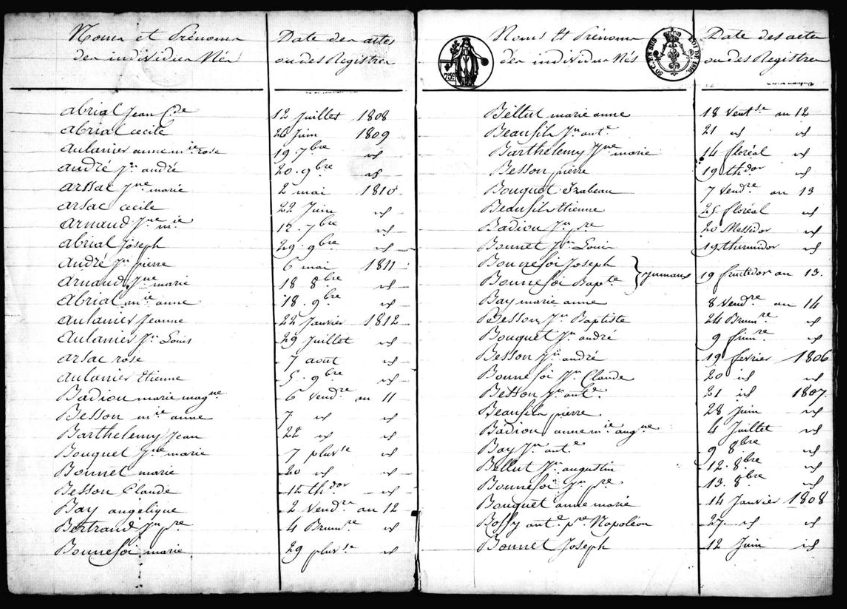
Ten-year civil record index, 1802–1882
Exhibit — decennial index

A ten-year civil record index (1802–1882) — one of the starting tools used to quickly locate a record before consulting the corresponding register.

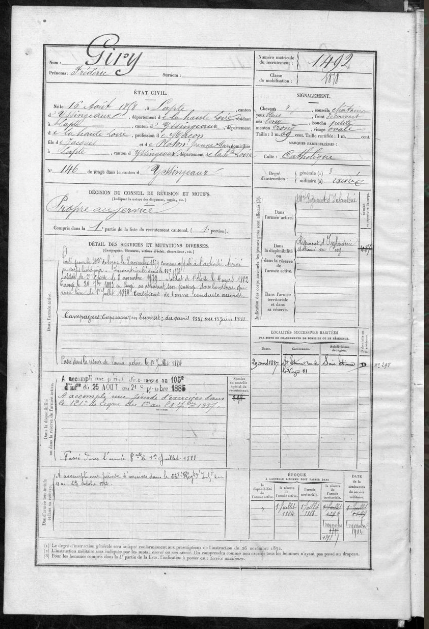
Military service record, 1878
Exhibit — service record

A military service record from 1878 — physical description, postings and campaigns, often the only source giving a precise description of the ancestor.

A starting point, even an incomplete one, is enough to begin.

Write to me with what you already know — even three names and a town are enough.

Get in touch